
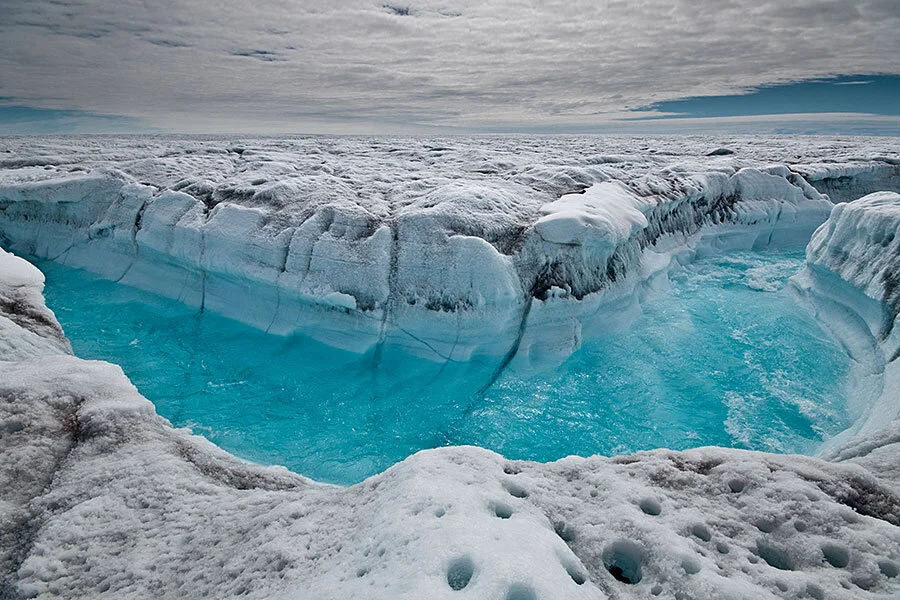
Greenland Ice Sheet Cracking at an Alarming Rate, Intensifying Climate Crisis
New research from Durham University reveals that Greenland’s melting ice sheet has contributed 14 mm to global sea level rise since 1992. This increase is caused by rising air and ocean temperatures fueled by climate change. Scientists warn that the situation worsens as glacier cracks expand and ice movement accelerates.
How Greenland’s Ice Sheet Impacts Climate
Greenland holds enough ice to raise sea levels by 7 meters (23 feet) if the entire ice sheet melts. Even if only a portion melts, projections suggest up to 30 cm (1 foot) of sea level rise by 2100. This could have catastrophic consequences for coastal cities, marine ecosystems, and global weather patterns.
Expanding Crevasses Are Speeding Up Ice Loss
The study found that glaciers at the edge of Greenland’s ice sheet are showing:
A 25% increase in crevasses in some areas, making the ice sheet more unstable.
A brief slowdown at Sermeq Kujalleq, Greenland’s fastest-moving glacier, temporarily offset some ice loss.
There has been a renewed acceleration of ice movement, signalling that the period of balance between crevasse growth and closure is over.
Why This Matters for Climate Change
As crevasses expand, they create a chain reaction that accelerates ice loss. According to Professor Ian Howat from The Ohio State University:
Glaciers move faster, pushing ice toward the ocean at an increasing rate.
Water and heat penetrate deeper, further weakening the ice sheet.
More icebergs break off (calving), contributing to rising sea levels.
This feedback loop could lead to an unstoppable decline in Greenland’s ice, with far-reaching climate consequences.
The Climate Crisis and Future Predictions
Climate experts emphasize that Greenland’s ice melt is a major contributor to rising sea levels, impacting millions of people in low-lying coastal regions. Some of the expected consequences include:
More frequent and severe flooding in coastal cities worldwide.
Disruptions to ocean currents, which regulate global temperatures and weather patterns.
Loss of Arctic ecosystems, affecting species like polar bears and seals.
Increased climate instability, with more extreme storms and unpredictable weather.
What Can Be Done?
Scientists are using advanced climate models to predict how quickly Greenland’s ice sheet will melt. These findings will help policymakers develop climate adaptation strategies, such as:
Investing in coastal defences to protect vulnerable areas.
Reducing greenhouse gas emissions to slow global warming.
Enhancing climate monitoring to track changes in Arctic ice.
Conclusion: Urgent Action Needed to Combat Climate Change
Greenland’s ice sheet’s rapid cracking is a warning sign of the accelerating climate crisis. Without immediate action, the melting ice will contribute to rising sea levels, impacting ecosystems, economies, and human settlements worldwide. Governments, businesses, and individuals must work together to reduce carbon emissions and invest in resilience strategies before it’s too late.
This article originally published at Outlookbusiness
