
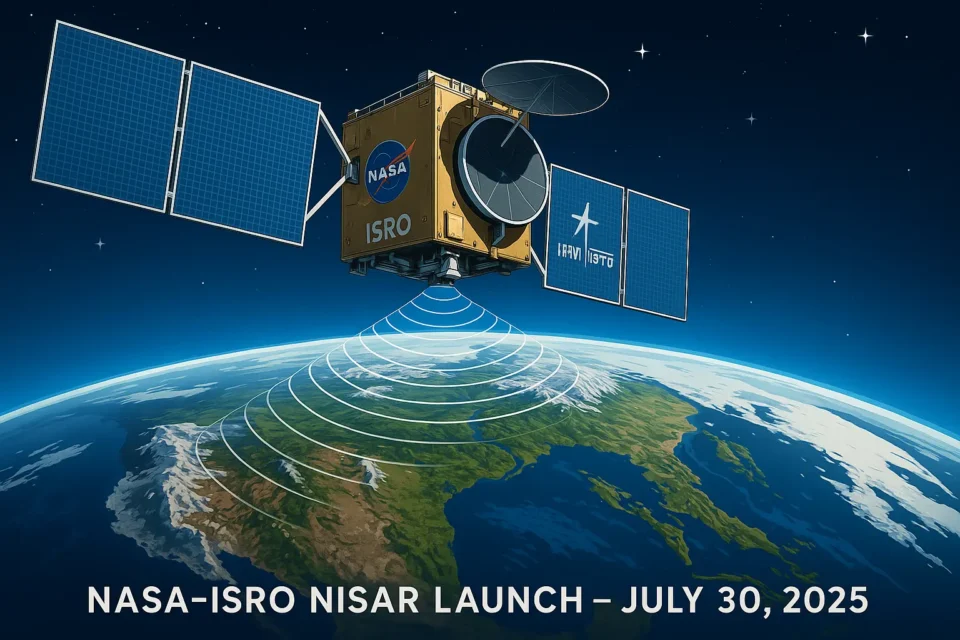
NASA-ISRO NISAR Satellite Launch Set for July 30, 2025: A Game-Changer for Earth Observation
The countdown has begun! The highly anticipated NASA-ISRO Synthetic Aperture Radar (NISAR) satellite is all set to launch on July 30, 2025, marking a historic collaboration between two space powerhouses—NASA (United States) and ISRO (India). This joint mission is poised to revolutionize how we monitor Earth’s dynamic surface and tackle the impacts of climate change, natural disasters, and more.
🌍 What Is the NISAR Satellite?
NISAR stands for NASA-ISRO Synthetic Aperture Radar. It’s a first-of-its-kind Earth observation satellite designed to provide unprecedented high-resolution data on our planet’s land and ice surfaces—every 12 days, globally.
It will be equipped with dual-frequency radars (L-band from NASA and S-band from ISRO), enabling it to:
-
Track crustal deformations caused by earthquakes and volcanoes
-
Monitor glacier movement and ice mass loss
-
Study land subsidence and landslides
-
Support agriculture, forestry, and water resource management
This data will be freely available to researchers and governments across the world, making it a critical tool in the fight against climate change and disaster preparedness.
🚀 Launch Details
-
Launch Date: July 30, 2025
-
Launch Site: Satish Dhawan Space Centre (SDSC), Sriharikota, India
-
Launch Vehicle: GSLV Mk II (Geosynchronous Satellite Launch Vehicle)
-
Orbit: Near-polar Sun-synchronous orbit
-
Mission Life: Minimum 3 years (2025–2028), extendable
🛰️ What Do NASA and ISRO Do?
NASA (National Aeronautics and Space Administration)
NASA is the United States’ space agency responsible for civilian space exploration, aeronautics research, and Earth and planetary sciences. Since its founding in 1958, NASA has led missions to the Moon, Mars, and beyond.
Key Achievements:
-
Apollo Moon landings
-
Mars rovers like Perseverance and Curiosity
-
James Webb Space Telescope
-
Climate and Earth monitoring satellites
ISRO (Indian Space Research Organisation)
ISRO is India’s national space agency under the Department of Space. It’s known for its cost-effective space missions, innovation, and growing international presence in commercial satellite launches.
Key Achievements:
-
Chandrayaan-1 & 3 lunar missions
-
Mangalyaan (Mars Orbiter Mission)
-
Record-setting satellite launches (104 satellites in one go)
-
Gaganyaan (India’s upcoming human spaceflight mission)
Together, NASA and ISRO bring world-class expertise and innovation to the NISAR mission.
🔍 Why NISAR Matters: Global Impact
NISAR is more than just a scientific project—it’s a global lifeline. With climate-related disasters on the rise, having access to real-time Earth deformation data could help:
-
Predict floods, landslides, and droughts
-
Guide better urban and environmental planning
-
Improve crop forecasting and yield
-
Monitor carbon stocks and deforestation
This makes NISAR a vital resource not just for scientists, but for policymakers, farmers, disaster management teams, and even insurance companies.
🧠 Final Thoughts
The launch of the NASA-ISRO NISAR satellite is a powerful symbol of international cooperation and technological excellence. As the world grapples with the realities of climate change and rapid environmental shifts, this mission offers hope through science, precision, and data transparency.
On July 30, 2025, when NISAR lifts off from Sriharikota, it won’t just be a rocket launch—it’ll be the launch of a smarter, more connected planet.
